
Agent Plugins 1.0: Portability Arrives—Governance Still Matters
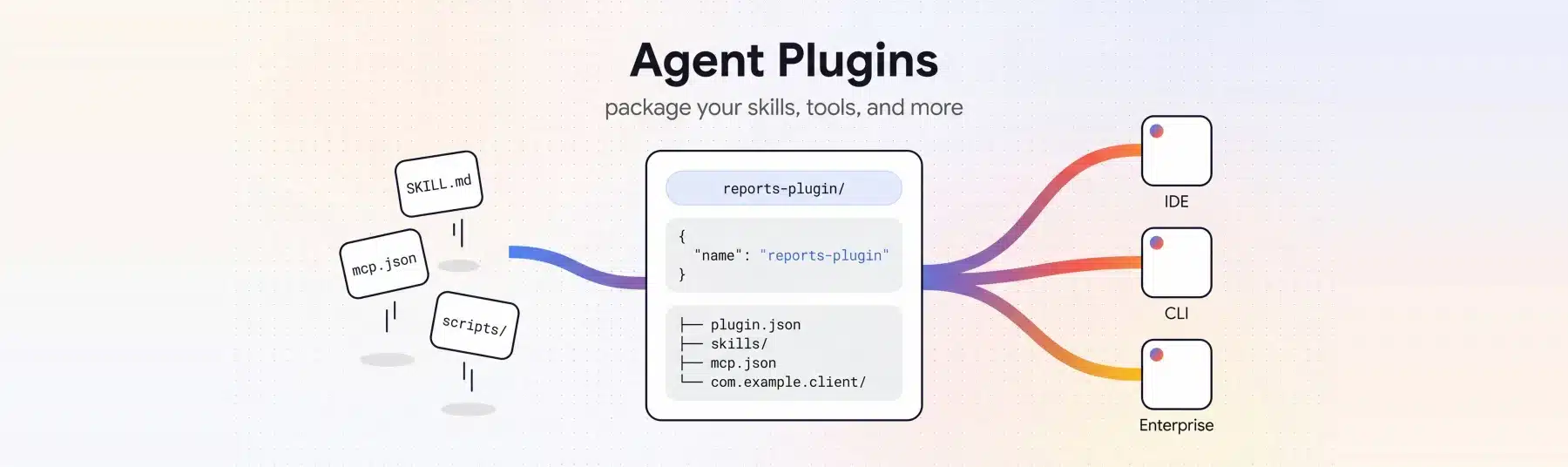
AI agents are becoming useful because they can do more than generate text: they can follow specialized instructions, call tools and connect to business systems. But every coding assistant and agent platform has packaged those capabilities differently. A useful integration built for one client often needs a second wrapper for another, creating duplicated configuration, inconsistent controls and version drift.
Google’s 6 August 2026 announcement brings that problem into focus. Google has joined Amazon, Cursor, Microsoft, OpenAI and Vercel as a core maintainer of Agent Plugins 1.0, an open, vendor-neutral format for packaging agent skills and Model Context Protocol (MCP) servers into a portable directory.
That is important plumbing for the agent ecosystem. It is not, however, a security certification. The distinction should shape how founders, operators and technical teams adopt it.
What Agent Plugins 1.0 standardizes
The format is intentionally small. A plugin is a directory with a plugin.json manifest. Reusable instructions and resources live in predictable subdirectories under skills/; MCP server definitions live in mcp.json; and client-specific capabilities can live in a reverse-domain extension directory that other clients simply ignore.
This gives clients a common answer to a basic question: where are the components and how should they be loaded? It also prevents one failed MCP server from disabling unrelated skills in the same package. The Agent Plugins 1.0 specification makes the portable core strict while leaving room for platforms to differentiate.
For a product team, the immediate benefit is lower integration maintenance. A reporting plugin, for example, can keep its database tool, analysis instructions and supporting scripts together instead of maintaining separate packages for an IDE, a command-line agent and an enterprise agent platform. A common structure also makes inventory, testing and ownership easier.
Why the timing matters
MCP has already standardized how agents communicate with tools and data sources. The surrounding ecosystem is now standardizing the other layers needed for production use. On 5 August, Google also described the 2026-07-28 MCP release candidate, which moves the protocol toward a stateless core suited to ordinary load balancing, serverless deployment and horizontal scaling.
Taken together, these developments show agent infrastructure moving away from bespoke demos and toward reusable platform components. That can shorten delivery cycles and reduce vendor lock-in. It also means capabilities will travel between teams and environments more easily—and anything that travels easily needs stronger lifecycle controls.
Portability is not trust
Agent Plugins 1.0 deliberately does not define an installation mechanism, distribution protocol, permission model, sandboxing requirement, trust policy or provenance verification. Those omissions are explicit, not accidental. A compact packaging standard should not pretend that an IDE, a local CLI and a regulated enterprise platform have identical security obligations.
The practical implication is simple: a valid plugin can still contain unsafe instructions, excessive tool access, vulnerable dependencies or an MCP server that sends data somewhere it should not. Schema validation can tell you that the package is well formed. It cannot tell you that the package deserves authority inside your organization.
A recent empirical study of 1,723 MCP applications, submitted on 28 July, shows why this gap matters. The researchers found that logging and enable/disable controls were common, but only 37.2% of the applications placed a blocking approval step in front of tool execution. In most of the studied applications, an enabled tool could therefore be invoked without a mandatory human checkpoint.
That does not make MCP or plugins unsafe by definition. It shows that interoperability standards and operating controls solve different problems. Teams need both.
A practical adoption model
1. Treat plugins as software supply-chain artifacts
Maintain an approved registry with a named owner, source repository, version, checksum, license and review status for every plugin. Pin versions in production. Do not automatically follow an unreviewed latest release. Require change review when a plugin adds a skill, script, dependency, MCP server or new client-specific extension.
2. Separate package review from permission approval
Review what the package contains, then decide what it may do in each environment. Map every tool to the data it can read, the actions it can perform and the identities it can assume. Default to read-only scopes and short-lived credentials. Production writes, deletion, payments, external communications and access to personal data should have explicit approval rules.
3. Run untrusted components inside a controlled boundary
Execute scripts and local MCP servers in a sandbox with restricted filesystem and network access. Allow only required destinations. Keep reusable secrets outside the package and inject task-scoped credentials at runtime. Record process starts, network requests and tool calls in logs the plugin cannot modify.
4. Test behavior, not only structure
Schema validation belongs in CI, but it is only the first test. Use representative tasks, malformed inputs, prompt-injection attempts, unavailable dependencies and denied permissions in staging. Confirm that failures remain isolated, approvals cannot be bypassed and sensitive data never appears in logs or model context.
5. Design for revocation and rollback
Teams should be able to disable a plugin centrally, revoke its credentials and return to a known version without waiting for every developer workstation to be repaired. Monitor usage by plugin version, tool, user and environment so an incident response team can identify exactly what ran and where.
What leaders should do next
- Inventory: identify the skills, scripts and MCP servers already distributed across agent clients.
- Pilot: package one low-risk, read-only workflow and test it in two compatible clients.
- Measure: compare integration effort, configuration drift, failure rates and review time with the current approach.
- Govern: define who can publish, approve, install, update and revoke plugins before broader rollout.
- Gate: require deterministic human approval for high-impact tool actions, independent of the agent’s own reasoning.
The Qomra Tech view
Agent Plugins 1.0 is promising because it standardizes the unglamorous layer that otherwise creates expensive duplication. For Gulf organizations building across multiple clouds, models and developer environments, that portability can preserve choice and speed up delivery.
The winning architecture will pair a small portable package with strong controls outside it: identity, policy, sandboxing, observability and revocation. Standardize how capabilities travel, then govern how much authority they receive. That is how interoperability becomes an operational advantage instead of a new source of hidden risk.