The Universal Work Agent Is Here. Your Operating Model Isn’t Ready.
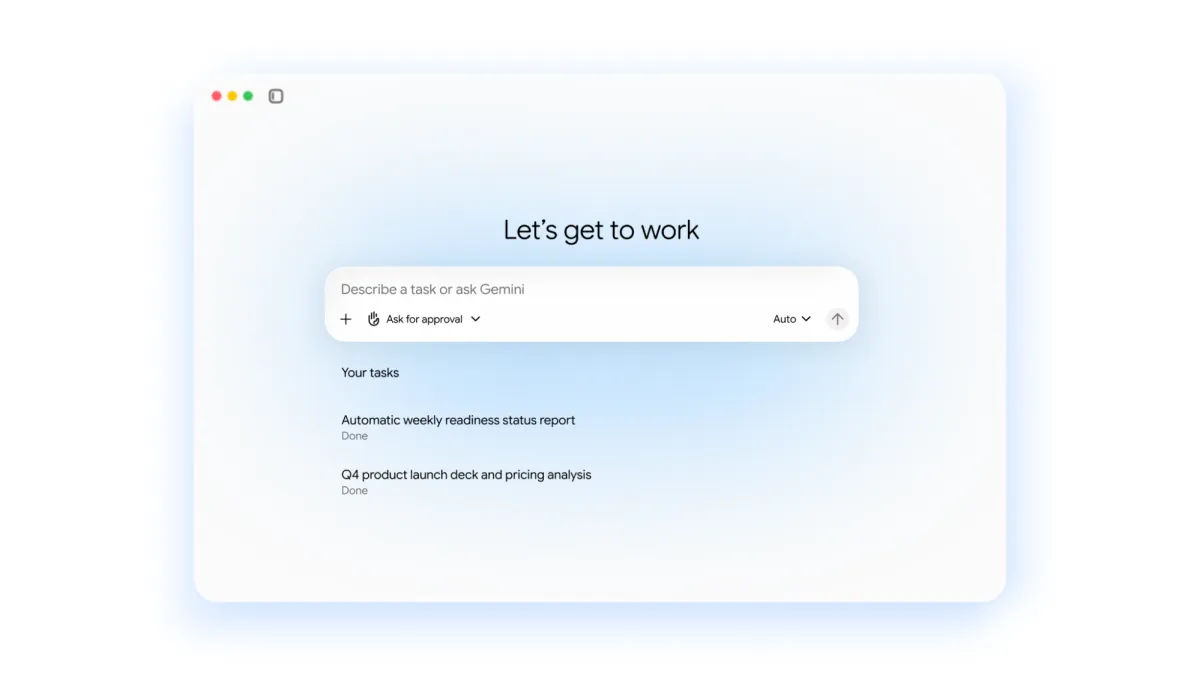
Google Cloud has introduced Gemini as a “universal agent for work”: one system that can move between email, documents, spreadsheets, code and business applications, carry context across those surfaces, and return a completed outcome rather than a single answer. That is a meaningful product shift. It is also an operating-model test for every company considering it.
The important question is no longer, “Which employees should get an AI assistant?” It is, “Which business outcomes can be delegated, under what authority, and how will we know the work is correct?”
What changed on 8 October
In its Gemini at Work 2026 announcement, Google described an agent that accepts objectives, selects tools and skills, works across systems and can keep running over longer tasks. A “coworker agent” can have a persistent role, its own identity, email address, calendar and storage. Google also says the agent can connect to services including Microsoft 365, Slack, Salesforce, ServiceNow, Jira and data platforms, as well as tools exposed through the Model Context Protocol.
This builds on the cross-application capabilities Google detailed in its September Workspace update: gathering context from selected email and files, then creating structured documents, spreadsheets or presentations without forcing the user to restate the project in every application.
For founders and operators, the attraction is obvious. A lean team can hand off the repetitive coordination surrounding sales preparation, project reporting, customer follow-up, finance packs or product research. Google’s SMB announcement frames the new agent in exactly those terms: an extension of a small team that already uses Workspace and connected business tools.
But a wide interface is not the same thing as a well-designed job.
Do not deploy a general agent into a vague role
People compensate for unclear processes with judgement, side conversations and institutional memory. An agent may reproduce the visible steps while missing those unwritten rules. The result can look polished and still be operationally wrong: a forecast built from the wrong version of a sheet, a client update that exposes an internal assumption, or a ticket closed before the customer has confirmed the fix.
The safest and most valuable first deployment is therefore not “help everyone with everything.” It is one bounded role attached to one measurable workflow.
A useful role definition fits on one page:
- Outcome: the business result the agent is responsible for producing.
- Inputs: the approved systems, records and events it may use.
- Output contract: the required format, evidence, recipient and deadline.
- Decision rights: what it may do automatically, what needs review, and what is prohibited.
- Owner: the person accountable for quality, access and continued usefulness.
For example, “prepare the Monday delivery-risk brief from Jira and the support queue, cite every flagged item, and submit a draft to the operations lead” is a deployable role. “Act as our project manager” is not.
Five controls that turn access into reliable delegation
1. Give the agent its own identity
A persistent agent should not borrow a founder’s account or a shared administrator credential. Google’s announcement says coworker agents act under their own identity and that actions are written to an attributable audit trail. Use that separation. Grant only the folders, projects, queues and API actions needed for the role, and make access expire unless the owner renews it.
2. Put checkpoints at irreversible moments
Human review is most valuable immediately before an external message, payment, production change, data deletion, contractual commitment or permission increase. Reviewing every intermediate step destroys the time saving; reviewing only the final dashboard may be too late. Design approval around reversibility and impact.
3. Require evidence with the output
A completed deliverable should include its source records, timestamps, assumptions and unresolved conflicts. This makes review faster and protects the team from confident synthesis based on stale or incomplete context. It also creates a trail for improving the workflow instead of merely arguing about the final answer.
4. Measure accepted outcomes, not activity
Tokens, prompts and tasks completed describe consumption. They do not prove value. Track first-pass acceptance rate, time to verified output, reopen or correction rate, exceptions requiring human rescue, and fully loaded cost per accepted outcome. Google highlighted smart model routing and real-time spend caps in the launch; teams still need to connect those controls to business-quality metrics.
5. Manage the role through a lifecycle
Tools change, source schemas drift, teams reorganize and old permissions accumulate. Treat every agent role like a production service: named owner, versioned instructions, test cases, access review, incident path and retirement criteria. Persistent memory should have retention and correction rules too. A long-lived agent can preserve useful context, but it can also preserve an outdated exception.
A 90-day adoption path
Weeks 1–2: choose the workflow. Find a recurring process with digital inputs, a clear recipient, frequent handoffs and a visible definition of done. Capture the current cycle time and defect rate before adding AI.
Weeks 3–6: run in shadow mode. Let the agent prepare the work while a person still performs the process. Compare outputs, document hidden rules and build a small evaluation set from real cases—including exceptions, bilingual content and incomplete records.
Weeks 7–10: allow bounded action. Automate reversible steps and keep approval at the impact points. Review evidence, not just prose. Instrument cost, latency, corrections and escalation reasons.
Weeks 11–12: decide whether to scale. Expand only if the agent improves an outcome without increasing hidden review work or risk. Reuse the successful role definition, evaluation set and access pattern; do not simply copy a broad permission profile to another department.
The Qomra Tech view
Universal agents will make integrations easier to demonstrate, but lasting value will come from the workflow around the model: clean data boundaries, explicit ownership, observable handoffs and small services that expose safe business actions. This is product and operating-model work as much as it is AI work.
If your team is considering a work agent, begin with one consequential but recoverable process. Define the job before selecting the tools. Build the evidence and approval path before granting write access. Then measure whether the business outcome—not the demo—improves.
That is how a universal agent becomes a dependable colleague: not by giving it every system on day one, but by giving it a role the organization knows how to govern.